

I spent my teen years in Louisiana and used to hear people emphasize the truthiness of their tall tales by declaring, “It’s the gospel truth!”
Whether gossiping about Bobbi Jo and her bad batch of overpriced Meth, or the way Bobbi Jo’s snake-handling husband performed at church last night, any seemingly incredible story became plausible when affirmed with, “It’s the gospel truth!”

I swear, that Bobbi Jo, she did it again, did you hear? Now, I don’t want to go spreading rumors, but I heard she got… she got… Oh, I don’t know if I can even say it. It’s so horrible… She got A TATTOO! I know it’s shocking, but I swear, it’s the gospel truth!
In the southern U.S. “the gospel truth” holds great power because it is closely associated with the Bible, which an astounding number of Americans believe is “the gospel truth.” Most people raised in the American South are indoctrinated into a pseudo-Christian culture that believes more in an infallible Bible than anything Jesus has to say.
The problem people who profess an inerrant Bible ignore is the irrefutable archaeological evidence that proves the Bible was written over thousands of years, by as many hands.
In particular, the Second Testament was written by people many decades removed from Jesus, none of whom knew him personally, each with a particular agenda. Those stories were later redacted and edited numerous times, often by Roman sympathizers who drastically changed the meaning of the stories.

Biblical literalists also conveniently ignore the Roman oligarchs who assembled the Second Testament. Gathered at Putin’s, I mean, Constantine’s villa, the oligarchs kept terrific records about their process — their debates, hopes, fears, and the evolution of the story they wanted to tell, which, again, has little or nothing to do with the story Jesus wanted to tell.
We need to be honest with our approach to the Bible and admit there is no gospel “truth,” there is only gospel opinion.
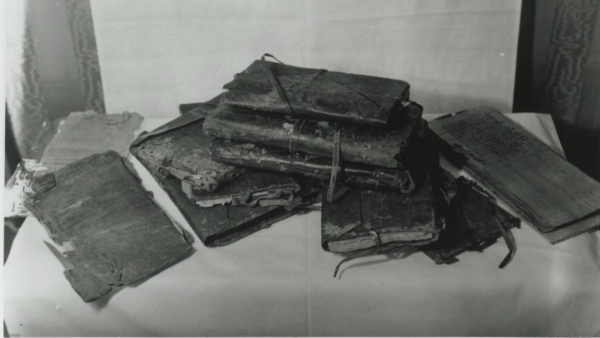
Complicating matters, an entire set of ancient texts was discovered near Nag Hammadi in the 1940s. These so called “gnostic” gospels, letters, parables, fantasias and other wonderful texts fill in much of what the Bible lacks. Of particular interest are the original sayings of Jesus found, without commentary, in The Gospel of Thomas.
Think of Thomas as the list of results that would come up if they had Google in the 1st Century. You’d type in “Actual sayings of Jesus” and The Gospel of Thomas opens on your iPapyrus.
The Gospel of Thomas is for Jesus Followers what the Dhammapada is for Buddha’s. They are books of the Masters’ sayings. Both allow us to approach the Masters without any of the commentary or pseudo- and mythological biographies of other authors, preferring instead to let the Master’s teachings speak directly to us with quiet, intense power.
Let me just add a caveat here: I realize that even books of quotations are filtered through an author. Still, Thomas is the only text that is even close to a collection of Jesus’ sayings. And while some of what he says in Thomas rings familiar, everything is also a little off, in a good, mystical way.
For example, we’re all familiar with Matthew 18:
Matthew 18.1–5 (CEB)
At that time the disciples came to Jesus and asked, “Who is the greatest in the kingdom of heaven?” Then he called a little child over to sit among the disciples, and said, “I assure you that if you don’t turn your lives around and become like this little child, you will definitely not enter the kingdom of heaven. Those who humble themselves like this little child will be the greatest in the kingdom of heaven. Whoever welcomes one such child in my name welcomes me.”
The emphasis in Matthew is on the humility of a child, but in Thomas, it is evident that is not at all what Jesus means:
The Gospel of Thomas 22
Jesus saw some babies nursing. He said to his disciples, “These nursing babies are like those who enter the kingdom.” They said to him, “Then shall we enter the kingdom as babies?” Jesus said to them, “When you make the two into one, and when you make the inner like the outer and the outer like the inner, and the upper like the lower, and when you make male and female into a single one, so that the male will not be male nor the female be female, when you make eyes in place of an eye, a hand in place of a hand, a foot in place of a foot, an image in place of an image, then you will enter [the kingdom].”
Thomas reveals Jesus the Wisdom teacher, the mystic, which is the way his students would have seen him while he was alive. Without the later commentary that turns Jesus into a demigod, Thomas allows the reader to more clearly understand the non-dual consciousness Jesus is teaching, a concept much more important and authentic than the divine sacrifice to which the Second Testament reduces him.
Matthew (and Mark, in his version) leaves out the important parts of the story, the mystical concepts about replacing one’s hands, feet, and eyes. That stuff is hard to understand, but I have to tell you, it’s the only stuff I think Jesus probably actually said, because it sounds like something a mystical teacher would say. Leaving it out causes readers to think faith should be approached with unquestioning acceptance and obedience to authority, which is the opposite of what Jesus is after.

Jesus knows that children don’t just happily do what they’re told, not for long, anyway. As soon as they can form words, kids incessantly ask questions and push back against restrictions. And that’s the attitude Jesus wants — not childishfollowers who worship the ground he walks on and believe God requires a human sacrifice, but critical thinkers who, in the best childlike manner, can’t stop asking questions.
When we begin to question in earnest, we discover a different type of Jesus, a more authentic Jesus. We realize he has nothing to say about human morality. He doesn’t even say anything about his death on the cross as a necessary payment for sin. None of that has anything to do with Jesus. Rather, Jesus is about non-dual consciousness, and if the Gospel of Thomas were canon, we would all know that already.
And the world would be a very different place.
Let’s carefully read the last paragraph of verse 22 again:
“When you make the two into one, and when you make the inner like the outer and the outer like the inner, and the upper like the lower, and when you make male and female into a single one, so that the male will not be male nor the female be female, when you make eyes in place of an eye, a hand in place of a hand, a foot in place of a foot, an image in place of an image, then you will enter [the kingdom].”
Jesus is teaching us non-dual consciousness, how to perceive everything as in harmony with the Great Source of Being, God, the Conscious Universe, the fundamental string. Whatever you call the unifying force of reality, Jesus says to look beyond black and white, male and female, positive and negative, and understand we are all one. When we realize we are an interdependent organism, not a bunch of independent cells, we find the God-space Jesus describes, a mettaverse ruled by loving-kindness, in which we are all avatars.
Jesus’ precise language about replacing the parts of the body with other parts hints at an understanding of the ancient Eastern idea of avatars, a concept entirely, and woefully, missing from contemporary Christianity.
The term avatar today describes the characters we play in video games or Virtual Reality. When I put on my VR headset my avatar, a digital representation of me, steps into the videogame. The spiritual idea of avatars works similarly and historically was reserved for gods.
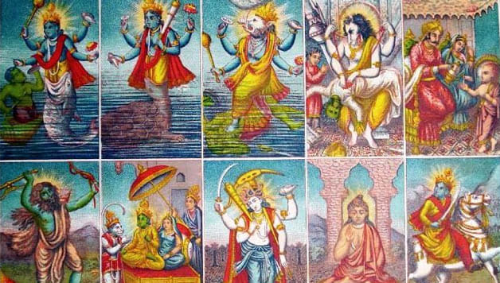
In Hinduism, for example, avatars of Vishnu appear in various times and places not only on Earth but across the metaverse. Vishnu’s eighth avatar is as Krishna, for instance. A spiritual avatar is like a god putting on their VR suit and visiting a different reality. So when Jesus says to make the inside like the outside, to understand we are neither male nor female but both; when we are told to fashion new body parts, he is talking about awakening to the reality of our being as avatars of God.
Jesus wants us to awaken the cosmic avatar within, to release our being to our astral image, the same image from which and in which Jesus is made. The same image in which and from which everything is made.
In The Gospel of Thomas, we hear Jesus say, “I’m here to help you find God’s avatar within yourself, all of you. But I won’t do the work for you. I can’t do the work for you! You all have to do the hard work of replacing your old ideas with new ones and letting the love within you flow out of you and freely through the world, waking everyone up as it does.”
May it be so.
Question: How might thinking of ourselves as avatars change our behavior, for better or worse?