
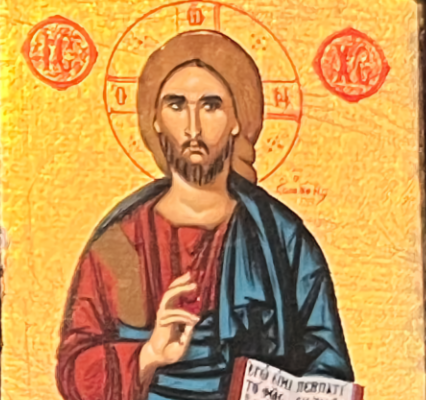
I have a traditional Byzantine Jesus icon on my desk. I am beyond thankful it survived the disaster that was our move from Florida to New York.
It’s a gold-leaf, handmade portrait of the Christ I purchased while visiting one of the world’s oldest Christian iconographers in Turkey some years ago.
Their workshop is a sanctuary of loving craftwork, an homage to Jesus the carpenter, whom I imagine chose and refined his construction materials as thoughtfully as his words.
Entering the artisan’s sanctuary is stepping back 1000 years in time. The atmosphere is thick with silent reverence but for the scraping and tick-tick-tacking of handmade wooden chisels and hammers, stained and pitted from decades, perhaps centuries of use.
Brick and mortar walls tower overhead, leading the eye to a vaulted ceiling supported by hand-hewn beams the size of the Titanic. I remember thinking, somebody hacked those and hoisted them up there, and the dedicated effort still astounds and inspires me.
At the entrance are stacks of reclaimed or purposely grown hardwoods, haphazard pieces jutting over and under each other much like the serpentine, cliff-edged road on the journey up the mountain to the workshop.
From this raggedy, resurrected stock, Master Woodcarvers form foundations and frames for the fine artists whose whispered brushstrokes create the Tree of Life, Jesus, the apostles, and a host of other familiar scenes from Christian stories shared for thousands of years.
There is no TV, radio, or computer. There is no social media, no noise, just the blissful, reverent sounds of inspired creativity. The entire workshop is a tribute to God’s craftwork bursting forth from within us.
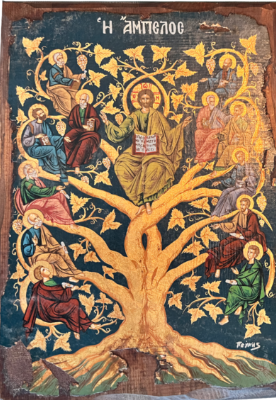
My icons (I also have a Tree of Life, maybe my favorite symbol) remind me of and connect me to that unique space and those faithful, patient, careful craftspeople whose spiritual art recalls Christianity’s heritage of beneficence.
The Jesus I know and see reflected in the gold leaf is a human capable of acts of loving-kindness, unconditional love of strangers, and a demand the entire society care for those on the fringes.
And Jesus says he is like this because God makes him so. And Jesus says that if we, too, look deeply within, we’ll be capable of even greater acts of loving-kindness.
Icons, Byzantine icons particularly, invite us to imagine the earliest days of the Christian story, as a legion of Jesus communities worked out what it meant to follow, believe in, or otherwise focus on Jesus as a God bringer. Those ideas eventually formed into sects and denominations segregated by their images of Jesus.
As early as 150 years after the Crucifixion, Jesus’ name was used to support numerous belief systems, many of them outrageous.
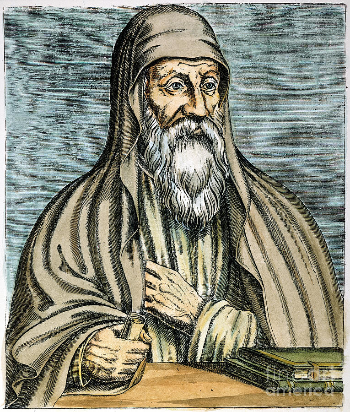
For example, the much-loathed Marcion proposed that the God of the First Testament was, in fact, not God at all, but a demiurge, a lesser God to the God Jesus revealed.
Marcion’s “bible” consisted of only ten Pauline letters and part of Luke, which he renamed “The Gospel of Christ.” Since then, Jesus has been used to support all sorts of heinous human activities, including, of course, slavery and nationalism.
It bothers me, deeply, to see Jesus, the ultimate icon of love, weaponized for hateful human endeavors.
And because part of my calling is interacting with people who hold different images of Jesus, often ones that supports bigotry and hatred, I find myself glancing slightly left of my monitor more often, where my ironically lavish, gilded icon of Jesus urgently reminds me to lavishly gild my neighbor with compassionate love.
My icons bring me comfort and inspire me to remain centered in realization of Oneness. They also remind me that Christianity is ultimately about God’s intense love for humanity, a love Jesus demands his followers extend to all people.

Christ compels me to share God’s unconditional, forgiving, reforming love with everyone in the world, whether we’re called Christian, Buddhist, Jew, Muslim, Atheist, None, or Done.
God’s love doesn’t require everyone to believe the same way or even to believe anything at all because God’s love is about a transformation of mind, body and soul so profound we see God not only in our icons, but also in our neighbors, enemies, and strangers.
Love is the Conscious Universe’s homeostasis and what it is inevitably expanding toward.
Some intentionally seek more profound understanding and experience of this Conscious Universe, but frequently God finds us first. Such is the power of universal love.
We necessarily collect different words, images, and ideas about God throughout our lives. Still, I find the concept that God is love essential to our spiritual progress, both individually and collectively.
If, as disciples of Christ, we want the Realm of God to appear here and now, then we need to take all the many concepts, everything we’ve learned, every idea we like, and perhaps especially, the ideas we don’t like — and let them gestate in the silent power of God’s presence, whether we’re in a workshop in Turkey or a Walmart in Tulsa.
We all just need to take a break from the noise and make space for God, who silently encourages us to soften our hearts and open our minds.
Silence.
Someone once said to the great Islamic mystic Rumi, “If you believe in silence, why have you done nothing but talk and talk and write and sing and dance?” Rumi laughed and said, “The radiant one inside me has never said a word.”
Like Jesus and other mystics, Rumi understands God as Essence and intuits that God and we are continually having a wordless conversation. Sting sang, “we are spirits in the material world,” and for millennia religious people have talked about body and soul, but Jesus teaches there is no difference between spiritual and material worlds. They are all a part of the same fundamental, God.
We necessarily use lots of words, icons, and ideas to describe God, but ultimately, they’re only helpful if they lead us to God as the essence, what Heidegger called presence: God’s calming, creative, all-knowing, silence.
A silence that somehow says everything.
Scripture such as Psalm 46 and the Holy Qur’an chapter 50 are designed to help us understand the ancient mystical concept of God as the essence of our being.
Psalm 46.10–11 (NIV)
He says, “Be still, and know that I am God; I will be exalted among the nations, I will be exalted in the earth.” The Lord Almighty is with us; the God of Jacob is our fortress.
Qur’an 50.16:
And We have already created man and know what his soul whispers to him, and We are closer to him than [his] jugular vein.
For eons, people worldwide have imagined a God not separate, but intimately, sub-atomically, the core of our entire existence.
In holy books from Israel to India, in the First and Second Testaments, the Qur’an, the Dhammapada, the I Ching, and more, God is nearer to us than our own breath.We are because God is.
God is the master crafter, an artisan of astronomical proportions also closer than our own breath. God is the intelligence that inspires us to create iconic reminders of God’s wondrous, overwhelmingly gracious love and presence in Jesus.
Perhaps, God sees all of us as icons, every one of us a precious, individually-crafted masterpiece created to inspire others to acts of loving-kindness that will eventually change the world.
Amen.
Question: What would you want an icon of you to symbolize?