

“Cheshire Puss,” [Alice] began, rather timidly, as she did not at all know whether it would like the name: however, it only grinned a little wider. “Come, it’s pleased so far,” thought Alice, and she went on. “Would you tell me, please, which way I ought to go from here?”
― Lewis Carroll, Alice’s Adventures In Wonderland
“That depends a good deal on where you want to get to,” said the Cat.
“I don’t much care where–“said Alice.
“Then it doesn’t matter which way you go,” said the Cat.
“–so long as I get SOMEWHERE,” Alice added as an explanation.
“Oh, you’re sure to do that,” said the Cat, “if you only walk long enough.”
The Cheshire Cat describes my writing pangs this week. Initially, I had another topic in mind, but once I found this passage from Alice, I ended up heading down an entirely different path. As long as we get somewhere, I suppose.
I’ve read both Alice books many times. They are literary masterpieces that keep me coming back as much to learn from Carroll’s style and imagination as to read the engrossing tale again.
At their core, the Alice books are about discovery and the beauty of a spiritual journey simply for the sake of taking the journey. Alice doesn’t have an endgame in her travels. She’s just chasing a white rabbit, tripping through Wonderland, meeting new creatures, rarely thinking about how weird it is she’s smoking hookah with Caterpillars or having tea with hatters and hares. Alice’s is a truly wonderful life. We should all have tea with hatters and hares. Maybe it would help us become re-enamored of this wonderland in which we live.
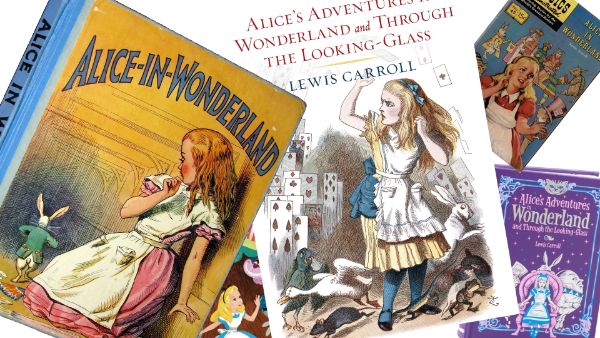
It’s easy to fall into the pit of despair and dystopia when our world is in so much turmoil; when bullies invade state and personal sovereignty; when people worldwide suffer from unnecessary and artificial shortages of food, healthcare, housing, and water; when our planet, without whom we cannot exist, lays dying, feverish from our catastrophic exploitation and runaway greed.
Alice in Wonderland reminds us this world is a living entity supporting billions of living creatures. We’d see that, understand it, and better care for the world and each other if only we had the insatiable curiosity that encourages Alice to jump into a black hole.
While Carroll didn’t have quantum physics in mind when he wrote Alice in Wonderland and Through The Looking Glass, they are remarkable in depicting our modern multiverse. In Through The Looking Glass, Alice walks into another dimension by way of a mirror—something many Victorians thought was a plausible function of mirrors, by the way.
Alice in Wonderland is even more quantum. Consider that, in the first few paragraphs, Alice falls through a rabbit hole that is actually a wormhole into another dimension. Then, when confronted with a door through which she won’t fit, she thinks, I wish I were like a telescope, so I could make myself small enough to work through the door. In the short time it has taken her to fall through the wormhole, “Alice had begun to think that very few things indeed were really impossible.”
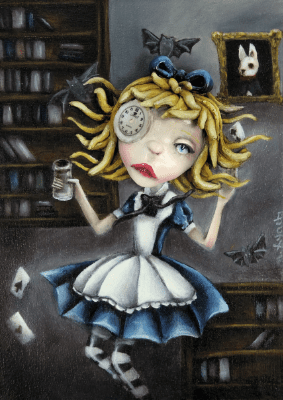
There’s an attitude the world could use more of. Very few things are impossible.
Once Alice finds the key and makes herself small enough—outstanding spiritual metaphors—her journey leads to new and strange discoveries. Throughout the novel, Alice finds her voice. She is empowered—not necessarily by the situations and characters–but by the journey itself. By the time she reaches our friend the Cheshire Cat, she realizes the trip isn’t about getting anywhere but rather about going everywhere.
I don’t much care where I go, so long as I get somewhere is a fantastic approach to life. And as the Cheshire Cat reminds Alice, “You’re sure to get somewhere.”
As long as you keep moving, of course.
And Alice certainly keeps moving. Her insatiable curiosity reflects Victorian Era attitudes. As the 19th Century turned 20, people were continually amazed by recent discoveries in paleontology, biology, astronomy, and other sciences. At the same time, the Victorians were highly religious people, steeped in a medieval, superstitious Christianity with stern, severe images of a punishing God with little tolerance for mistakes. For the most part, people were terrified of the prospect of eternal hell rather than nurtured and consoled by a forgiving, unconditionally loving God.
The sciences forced people to question whether or not what the Church said about the natural world was accurate.
The Church did not like that.
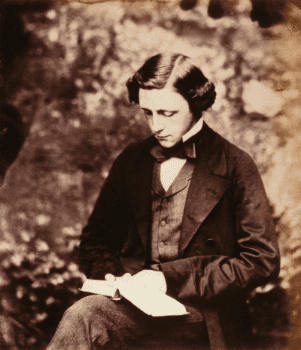
Lewis Carroll, whose real name is Charles Dodgson, was raised in a family whose men were Anglican clergy for nearly a century. His father was the parish reverend. A close relative was a Bishop, and Charles was a deacon. His parents expected Charles would join the clergy, but as the Church clutched superstition more tightly in a world awakening to God in the wonders of scientific discovery, Dodgson challenged the church’s views. The Queen of Hearts represents the High Anglican Church of Carroll’s era, proclaiming love yet beheading anyone who thinks differently, especially the scientists challenging the Church’s authority.
So, Alice represents an amalgamation of Victorian-era change agents. She is the holy curiosity of childhood freed from religious constraints to learn more about the universe by actually learning how the universe works.
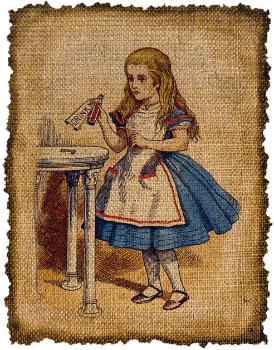
Alice has an insatiable thirst for learning and joyfully experiences the wondrous world around her. She has the inquisitive mind necessary for both scientific and spiritual growth. Her confidence, willingness, and ability to speak truth to power make her a fantastic feminist hero and a spiritual archetype for everyone looking for Wonderland. Alice’s open-minded, experience the now attitude is a prerequisite to the spiritual momentum the Cheshire Cat suggests is necessary if we want to avoid the stagnation that turns all of us into pawns in someone else’s game.
It takes Alice to call the entire charade out, to point out that both church and state spew nonsense, which, in a nonsensical world, is quite a feat. But in revealing that the king’s and queen’s power is built on fear alone, their house of cards collapses, and the pawns are free to revel in the delightful weirdness of Wonderland; to travel everywhere and nowhere, but always going somewhere.
So, which way do we go from here?
Question: Which way do you want to go, spiritually speaking?