
Fifty days after Easter, Christians worldwide celebrate Pentecost and read from Acts 2 about the Holy Spirit descending on an entire crowd, filling people from different cultures with profound cosmic understanding. Somehow, that massive consciousness-awakening event turned into a celebration of the “birthday of the church,” but that’s only because the “Church” likes to put itself at the center of the universe.
Acts 2.1–8 (CEB)
When Pentecost Day arrived, they were all together in one place. Suddenly a sound from heaven like the howling of a fierce wind filled the entire house where they were sitting. They saw what seemed to be individual flames of fire alighting on each one of them.They were all filled with the Holy Spirit and began to speak in other languages as the Spirit enabled them to speak. There were pious Jews from every nation under heaven living in Jerusalem. When they heard this sound, a crowd gathered. They were mystified because everyone heard them speaking in their native languages.
They were surprised and amazed, saying, “Look, aren’t all the people who are speaking Galileans, every one of them? How then can each of us hear them speaking in our native language?
For the original Jewish authors, readers, and listeners, the Pentecost account found in Acts 2 symbolized not a birthday for a church they weren’t even thinking about starting but a breakthrough in human transcendental thought that answers a question first posed by the authors of the Tower of Babel myth: How can we understand each other — how can we accomplish anything spectacular — if we’re not speaking the same language?

The importance of Pentecost is the concept of the Holy Spirit as an information conduit translating human speech into understanding.
We often speak of the Holy Spirit as this esoteric, ethereal “thing” that occasionally ignites us with religious fervor, but I think the early followers of Jesus, and definitely, the author of Luke-Acts, thought of Spirit more practically, like a fiber optic cable that carries information from God to and through people.
When everyone tunes into the same Godflow channel, you get mass awakenings like the one described at Pentecost, where people understand each other on a level that transcends language.
It’s easier to see the spiritual importance of the Pentecost narrative if we think of it as a sequel to Genesis 11, the Tower of Babel.
Genesis 11.1–9 (CEB)
All people on the earth had one language and the same words. When they traveled east, they found a valley in the land of Shinar and settled there. They said to each other, “Come, let’s make bricks and bake them hard.” They used bricks for stones and asphalt for mortar. They said, “Come, let’s build for ourselves a city and a tower with its top in the sky, and let’s make a name for ourselves so that we won’t be dispersed over all the earth.” Then the Lord came down to see the city and the tower that the humans built.And the Lord said, “There is now one people and they all have one language. This is what they have begun to do, and now all that they plan to do will be possible for them. Come, let’s go down and mix up their language there so they won’t understand each other’s language.” Then the Lord dispersed them from there over all of the earth, and they stopped building the city. Therefore, it is named Babel, because there the Lord mixed up the language of all the earth; and from there the Lord dispersed them over all the earth.
Both Acts and Genesis 11 concern the Jewish people’s profound struggle to maintain their own identity morally, theologically, and linguistically in a world being homogenized first by Babylon and later by Rome. Babel warns us that, while it might be easy to accomplish something incredible with people who are just like us, that incredible something might be a nuclear weapon, or a great wall, or an iron curtain.
Acts 2 addresses that apprehension by illustrating all those previously dispersed people are still united, connected, and entangled by something we sense but cannot yet find. Our faithful scribes called it “Holy Spirit.” We might call it quantum entanglement.
We might not be aware of the relationship between Acts and Babel if someone taught us that the moral of the Babel myth is that humans were proudly trying to build their way to heaven or as an explanation for why there are thousands of human languages. But there is no mention of God’s destruction of Babel in the biblical account.
In the text, God comes down from heaven to check out our human handiwork, seemingly impressed! God doesn’t destroy anything. And that humans are dispersed around the globe developing different languages has been previously mentioned in Genesis 10:5. So, the Tower of Babel has nothing to do with creating languages or even our lack of humility toward God.
Babel warns us of the dangers of homogeneity, walled gardens, and groupthink — honest and genuine threats to any civilization, as we are learning all too well in 21st Century Amerika.
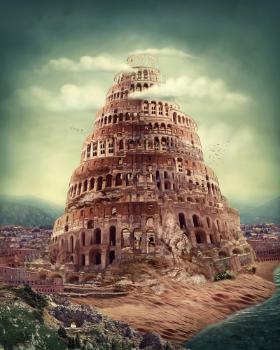
However, in the story, people are building a tower so they won’t be dispersed, an unceasing problem when one’s a Jew. Which begs the question, “Why does God have a problem with this,” one of the few times in the Bible we’re shown to be capable of getting along well enough to accomplish something magnificent?
Think about the inventiveness required to build a tower 4000 years ago. Even five stories of mud-brick would have been astounding, not to mention baking mud into hard bricks to build towers and fortifications in deserts with no available stone. Genius!
Ziggurats and towers were reasonably familiar sights by the time the Tower of Babel story was written. The Ziggurats were built to mimic mountains and often served as temple platforms, where people went to feel closer to the gods. Towers were also common fortifications for cities, especially cities built in the middle of a desert.
It seems the building of the tower of Babel is a perfectly natural event. So, if not just to mess with us or punish us for trying to protect our town, why does God confuse the people’s language so they can’t complete their massive public works project?
The first line is revealing: All people on the earth had one language and the same words. We know that’s not true, and we know the authors of the story knew that wasn’t true because they already wrote as much in Genesis 10. All the people on the earth didn’t speak one language, so confusing everyone’s speech and scattering them around the globe can’t be the point of the Babel myth.
Instead, the Tower of Babel is an astoundingly prescient treatise on the danger of carrying an identity statement so far we shut the doors on anyone we don’t like. It’s a problem the ancient Jewish people struggled with when they were in power and when they were helplessly surrounded by it.
The story is thrilling to read because it clues us in to how people were first organizing proto-modern civilizations. And today, it is a shocking reminder that we too often and easily fall prey to the beast of xenophobia.
No, Babel isn’t about language, it’s about homogenous tunnel vision. Being so blind to other people and cultures, you think everyone is just like you (or should be) and your culture is the best! (or should be). It’s that attitude that gets God’s goat and the reason God eventually disperses the people all over the globe speaking different languages.
Because the best way to deal with xenophobia is tearing down walls, not building towers.

The ancient authors understood Babel as a cautionary tale about walling yourself off from the rest of the world because your group is in with God and everyone else is out. God does not tolerate intolerance, even from — especially from — God’s chosen people.
It’s fine to want to make a name for yourself. It’s not okay to say your name is the only authentic and legitimate one. It’s a superiority complex that brings God’s wrath to Babel.
Maintaining a cultural identity while also understanding you’re not the only ones with a cultural identity is a theme that runs throughout the First Testament as the Jewish people settle, organize, and are destroyed by more powerful neighbors in a cycle that, unfortunately, persists today.
By the time the Tower of Babel story was written, the Jewish people had escaped captivity more than once and were likely captives again, this time in Babylon, where they may have first heard about the Tower of Babel, a myth dating to the Sumerians.
It’s easy to see that people continue to build all sorts of fortresses and towers for themselves, and one of our most effective is still linguistic. Hiding behind words, we lock away the seeming foreignness of the world to preserve our own culture. The French do this literally, doing backflips to avoid “polluting” their language with terms like “esports” or “streaming.”
Sometimes, we preserve the life right out of our culture.
Babel shows us that the power of language to divide us into insiders and outsiders leads inevitably to the creation of towering fortresses because it’s easier to cloister ourselves away with people who think just like us than to deal with people we don’t understand. And I mean that literally and metaphorically.

Today, we are nearly 8 billion people. We couldn’t build a Tower of Babel if we tried because, for all our languages, we barely speak to each other. There is no common tongue and certainly no shared vision. And although we now have excellent universal translators that should help us create international, borderless communities, we instead continue to form homogenous hive-mind subcultures, sequestering ourselves behind the glowing digital walls in the back alleyways of our postmodern Babylon, using increasingly coded language to distinguish our group from another.
It’s as if the Tower has taught us nothing. Probably because we were too busy celebrating a birthday that never happened.
The appearance of the Holy Spirit at Pentecost is an innovative solution to our human tendency to form into special interest groups, SIGs. I think the author of Acts 2 had Babel on their mind while writing because Acts is an elegant, grace-filled solution to human xenophobia.
When, individually, we tune into the cosmic information flow that Spirit represents in Acts, we discover an understanding that transcends human babel and weaves us together as the unique and distinct people we are.
We don’t all have to be the same. According to the writers of the Babel myth, God hates that. And while I don’t believe in a God with human emotions, nature indicates variety — heterogeneity — is paramount to the survival of any species: bird, flora, fish, or fauna.
Still, we need to communicate if we are ever to live in peace, and the author of Acts suggests we do that not by homogenizing everyone but by first tuning into the universal Godflow channel, where we discover the very spirit of being, every being, is the love language of God.
Question: What are the pros and cons of your towers of Babel, your walled gardens, your homogenous groups?