
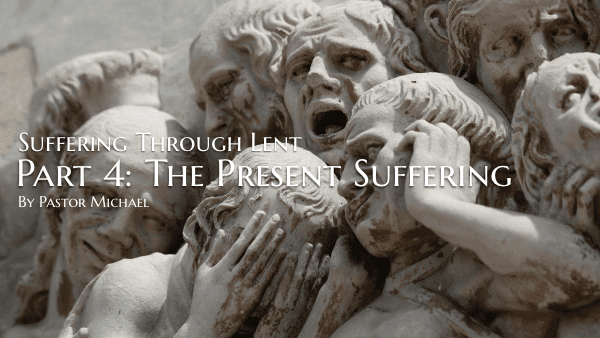
Part 4: The Present Suffering
Like millions of others, my great-great-grandparents walked out of Poland, kids in tow, to escape the atrocities of the First World War. I vaguely remember the whispered stories, overheard while I was supposedly playing in the next room, of silent mountain hikes in the dead of night; of loved ones lost to that war’s gaseous repugnance, an ominous harbinger of worse to come. Decades later, when the worse arrived, my mom’s dad lost his life storming the Normandy beach.

I’ve been thinking about my family as I watch, in horror, sorrow-full, as other people’s grandparents, and those who one day hope to be, are bombed out of existence because yet another madman has taken control of the machinery and minds of war. Because the human species has yet to learn how to coexist, or better, cooperate.
The present suffering is wordless wails through tearfalls of pain. Once again.
A monumentally conflicted world challenges our belief in a loving God. The war in Ukraine, global climate change, the rise of autocracies, the dumbing-down of societies being manipulated and controlled by multinational corporations, power mongers of systemic racism, and the corrupting influence of profit-at-any-cost is overwhelming. Where is God in all this? Why does it seem the entirety of creation is suffering?
For thousands of years, spiritually-inclined people have been dealing with the question of theodicy, or why a loving, all-powerful God permits or doesn’t do anything about human suffering. Our earliest answers (and, unfortunately, too many still today) were those bad things happen because the gods are punishing us for some offense, although humans also believed we suffered merely because the gods felt like messing with us.
Eventually, ancient Jews, adapting ideas from earlier Semitic and Eastern cultures, decide there is one God over all, and He is not so willy-nilly. They stop blaming or crediting God for every little thing and realize that if they don’t water the crops, they won’t grow. It’s nature, not God.
As nomadic tribes settled into towns, it became increasingly important for every citizen to do their part — not only for their neighbor but also for God. While early Judaism undeniably had as retributive a god as other cultures, the reason for that retribution rapidly evolves from peeved alien overlord to an entire people in a contractual obligation with theSupreme Being, the creator of everything seen and unseen.
That’s a big contract.
The Jewish people believe they are partners in a divine covenant with God, a covenant of love, mutual respect, and honesty. Breaking the Covenant created suffering for individuals and could bring the “wrath of God” down upon the entire community — not directly as fireballs and lightning from a wrathful super-being, but through invasions of their homeland, exiles, plagues and pestilence.
Individual good behavior was encouraged because one person’s mistake or arrogance could ruin the entire community. It’s a punitive theology, but we’re making progress. At least humans are now responsible for shouldering some of the burdens for the world’s woes.
People often read a petty, petulant God in the First Testament, but that’s not how the ancient Jewish people would have understood and told the stories. Jews are in an intimate relationship with God, especially in their time of suffering. Whether leaving Egypt to wander in faith for a lifetime or in exile in Babylon for three generations, Jewish or not, we’re to remember and know God is with us, suffering with us. Divine support is all we need from God.
From Amos to Jeremiah, the prophets remind us of our covenant relationship and the consequences of failing to live in right relationship with God. What is living in right relationship with God?
Let me make it simple for you: Don’t be a jerk.
When the Jewish people are exiled (2 Kings 24:8–17), when the fields dry up and there’s no yield from the grapevines (Deuteronomy 29:22–25), when a couple of bears maul a bunch of kids (42!) for making fun of a bald guy (4 Kings 2:23–24), the blame is placed not on a wanton act of God but on the people who have brought these circumstances upon themselves by acting in an anti-covenantal manner, disregarding the good of the society. Being jerks.
The Jewish people understood that actions have consequences, and they were beginning to develop the idea that consequences have less to do with a punishing god than with the natural consequences of our abuses, both personal and planetary.
The importance of theological movement from “the gods are doing this to me because I was bad” to “God is with me and loves me and is encouraging me to keep trying even though I messed up” cannot be understated.
God doesn’t “cause” anything to happen, anywhere, to anyone. Instead, God is with us in every unexpected moment of every life, laughing with us, crying with us; succeeding and failing with us; being born and dying with us.
In his masterful letter to the church in Rome, also struggling in a time of terror, Paul urges us to remember God is not punishing us for a transgression but birthing a new world through us. And birth is messy. And sometimes, violent.
Romans 8:18–25 (The Message)
That’s why I don’t think there’s any comparison between the present hard times and the coming good times. The created world itself can hardly wait for what’s coming next. Everything in creation is being more or less held back. God reins it in until both creation and all the creatures are ready and can be released at the same moment into the glorious times ahead. Meanwhile, the joyful anticipation deepens.All around us we observe a pregnant creation. The difficult times of pain throughout the world are simply birth pangs. But it’s not only around us; it’s within us. The Spirit of God is arousing us within. We’re also feeling the birth pangs. These sterile and barren bodies of ours are yearning for full deliverance.
That is why waiting does not diminish us, any more than waiting diminishes a pregnant mother. We are enlarged in the waiting. We, of course, don’t see what is enlarging us. But the longer we wait, the larger we become, and the more joyful our expectancy.
It’s not only around us, it’s within us, Paul says. The entire creation is reforming, and we’re all feeling it. We’re all pregnant with it!
Paul wrote almost 2000 years ago but his sentiment is as fresh and hopeful as today’s sunrise.
A new human, a new planetary covenant, is forming right now, at his moment. But, Paul came to realize that this moment for us might be generations, perhaps eons, for the universe.
The gestation period takes longer than most of us would like. Certainly, Paul expected this transformation in his lifetime. I wish it would happen in mine.
But the evolution of consciousness is unconcerned about human time. While we work to create a more equitable, compassionate world, we should not despair at the news of our heartlessness to one another. Instead, let us remember that the suffering of war and a feverish planet are not the end of civilization and certainly not the end of the world. Let’s remember that as God suffers with us, so do we suffer with our neighbors.
Our present suffering is merely the transformation of humanity’s currently inhumane incarnation dying to be born into a new, more equitable, reasonable, compassionate, and covenantal globe.
May it be so.
Question: How might we live in covenant?